|

|
Introduction
'Jeb Alexander'
is the pseudonym used for a homosexual man who was born on October
17, 1899. In the edited version of his diaries, Jeb and Dash,
first published in 1993, Jeb's niece and editor of his diaries, Ina Russell, shares Jeb's window on gay life in Washington, DC in the early half
of the twentieth century, spanning the years 1918 – 1945. The published version of his diaries was hailed by some in
the gay community as an historic look at gay culture during a time from which little such similar documentation exists.
According
to Russell's introduction to the edited diaries, in April 1962 Jeb wrote, "At last I wrote my letter to Ina…about
the diaries, asking her advice, and urged her please to answer soon." Ina continues, "On May 14 he [Jeb] received
my reply. He wrote, "Ina's looked for letter at last came and it made me quite happy. It was exactly what I had hoped
for, the answer I had wanted to receive from her. She was not sure that I had it in mind to leave her the diary, so she begged me to do so."[1]
Later in her introduction, Ina includes the following entry from Jeb dated 14 April 1923, which lends his perspective
on the sharing of his diaries:
It occurred to me today with something of a shock how horrible
it would be for this diary of mine to be pawed over and read unsympathetically after I am dead, by those incapable of understanding,
who would be filled with disgust and astonishment and think of me as a poor demented wretch, a neurotic or a madman who was
better off dead. And then the thought of the one thing even more dreadful and terrible than that—for my diary never
to be read by the one person who would or could understand.
For I do want my diary to be read—there
is no use in concealing the fact—by somebody who is like me, who would understand. [2]
Jeb was a collector of personal and published diaries, and this may have contributed to his understanding
that his diaries had meaning beyond himself. So even at the age of 23, Jeb knew that he wanted to share his diaries, though
it was not made clear to the reader what he had in mind for accomplishing this, not even when he writes to Ina concerning
the matter years later in 1962. Russell herself seems not to be sure when she writes that "Perhaps he left his diaries
to me as an act of faith between lovers of literature."[3] For my part, I had to wonder if perhaps Jeb had acted selfishly by imposing this task upon Ina, conveying his unspoken faith
in her that she would somehow see him and his diaries through to fruition, whatever form that might take. Whatever the case,
if it was an act of faith that led Jeb to entrust his diaries to Ina, then it seems to me that it was an act of unselfish
love on Ina's part to accomplish what she did for Jeb, not to mention for the others like him 'who would understand.' That said, however, after first reading Jeb
and Dash, shortly after it was published, I immediately became convinced that while Ina had managed to tell 'a'
story she had not told 'Jeb's' story. By failing to append his true name to what amounts to his life-long body
of work, she failed to make it his own. This point is particularly poignant, because it was Jeb's lifelong desire to be
a published author, according to published diary entries and Ina's own account. Unfortunately, Jeb's entries and Ina's
introduction reveals to us a man who instead succumbs to writer's block or inertia. Ina seems to understand the weightiness
of this when she writes: "If we lived in Kafka country, everyone who aspired to lead a creative life and does not would
be required to read the whole of Jeb's diaries, and then would have to appear in a silent courtroom before a faceless
judge who would ask: Do you understand? Do you know what will happen if you do not use your talent? And none would escape
by saying, But was it not enough that in my life I fell tragically in love?"[4] The reference to 'tragically in love' referring to Jeb's one-time lover and long-time friend, pseudonymously
presented as C.C. Dasham (Dash) in the edited diaries.
Ina had the opportunity to give Jeb in death the
one thing he could not accomplish for himself in life – the opportunity to be a published book author. That's not
to say that I deny what must have been the absolute monumental task of editing the expansive diaries into a single account,
and the importance of what Ina shared through Jeb from a gay historical perspective. In this sense, she and Jeb did this together.
He supplied the raw material and she shaped it and made it available to those 'who would understand.' What this observer
could not understand, however, is why Ina failed to make Jeb's story his own. By using a pseudonym to represent her uncle,
Ina denies Jeb his last chance to be a 'great author,' as Jeb once said of his own desires for himself –
well, at the very least, his own author.
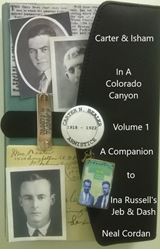
This seemed strange to me, considering that Ina had opted
to include in the book some photographs of Jeb and his family, and even one of Jeb and Dash together, prominently displayed
on the book cover. Part of her reluctance to spell 'Jeb' out, apparently, had to do with the practice
of 'outing' (i.e., publicly revealing that someone was gay or lesbian against his or her will) that was in wide debate
at the time Ina published Jeb and Dash. And, in fact, Ina states in her introduction "I used pseudonyms for
most private individuals because some people from Jeb's diaries may still be living, and certainly most of them have living
relatives. It was not my desire to bring anyone out of the closet without his knowledge or permission."[5] The question nagged: why then did she choose to share the photographs in the book if she was concerned that certain disclosures
would embarrass or distress living persons or their immediate descendents? Certainly, members of Dash's
extended family would likely recognize his photograph adorning the book jacket, and the same could be said of Jeb's relatives.
Even according to her own pronouncement, she did not know whether Dash was still living at the time of publication. Yet, not
knowing, she still chose to publish the edited diaries with Dash's picture on the dust jacket, alongside Jeb. As it turned
out, Dash had been deceased for some years, but she did not know that at the time. The act of disclosing the photo of Jeb
and Dash together on the jacket cover, then, can be interpreted as having outed them to their extended family lineages, and,
in the case of Dash, since Ina did not know if he was alive or dead, simply outing him, period.
But the fact is, from
the time of Jeb's death in 1965, it would take Ina until 1993 to edit and have published his diaries, some 28 years later.
In that time, almost all the major players in Jeb's text whom might have been outed had long since deceased. And
certainly Ina, with their real identities at hand, might have been able to deduce this through some background checking, which
she indeed later did with the help of a librarian who volunteered to do so, post publication. But as for Ina's desire
to apparently spare the 'living relatives' any embarrassment by having it publicly disclosed that they were related
to a gay person, I find that argument without merit. Jeb and the others did the hard part – they lived it, and in a
much less socially tolerable, and indeed sometimes hostile, time than homosexuals enjoy today. Now these souls are gone, and
I feel certain that their relatives would have survived the telling of their stories. As one lesbian archivist put it, "while
individual privacy and confidentiality may be of paramount concern while the individual lives, a full disclosure of deceased
individuals' history can do little harm and yet add so much to the lives of others."[6]
It has to be said, though, that without Ina, Jeb's legacy would have never been realized at all. And in the
end, I suppose that Ina is as much a product of her socialization as any one, concerning attitudes and mores regarding sexuality,
which seems evident when she writes: "Soon after I completed this project [Jeb and Dash] I shopped
for a gift in a men's store, and while my purchase was being wrapped I wandered around, browsing, and found myself wondering,
Which sweater would I like best if I were a gay man?"[7] The answer to her question is most likely 'the same sweater that any number of men might
like.' Granted, it cannot be denied that the modern gay stereotype has its basis of origin in some historical evidence,
but with the continuing evolution of the gay movement, homosexual men, other than those represented by 'that' stereotypical
image have emerged in full public view, perhaps helping to assuage that image as the only accepted norm for all gay men. Perceptions
can change over time, clearing a path for acceptance of homosexuals by even disapproving family members, as society at large
becomes less disapproving toward gay men and lesbians.
Despite whatever misgivings I may have had
about Ina's handling of Jeb's diaries, I think the truth is that it is precisely the way she chose to shroud their
contents in such secrecy that has generated energy surrounding the diaries, albeit perhaps unintentional. It's
easy, too easy, to sit in judgment of Ina's loving gift to her uncle, and to those who might understand, by those
who had no familial connection to Jeb and who did not accomplish the unwieldy undertaking that she did.
I
ponder that Jeb would be thrilled to know that his diaries will eventually reside in the Library of Congress, that his edited
diaries have been dramatized as a screenplay, and that there are other people, just like myself who have been riveted by his
story, seeking to learn something about themselves through the lives of Jeb and Dash. In all actuality, Ina's telling of Jeb's
story has generated a whole second life for him and his diaries. And when all is said and done, I think Jeb made exactly
the right choice in entrusting his diaries to Ina. Thank you, Ina.
[1] Ina Russell, ed., Jeb and Dash: Diary Of A Gay Life, 1918 – 1945
(Boston: Faber and Faber, 1993), 5. [2] Russell, ed., Jeb and Dash, 8. [3] Russell, ed., Jeb and Dash, 5. [4] Russell, ed., Jeb and Dash, 6. [5] Russell, ed., Jeb and Dash, 5. [6] Judith Schwarz, “The archivists balancing act: Helping researchers while
protecting individual privacy,” The Journal of American History, June 1992, 179 -89. [7] Ina Russell, ed., Jeb and Dash, 6.
All contents of this website Copyright ©2005 - 2012, Neal Cordan. You are prohibited from downloading, storing,
reproducing, transmitting, displaying, copying, printing, distributing or using any material found on this website without
first obtaining explicit permission from Neal Cordan. The copyright extends to all displayed images; all of which are copyright
their respective owners.
NealCordan@aol.com
|

|

|